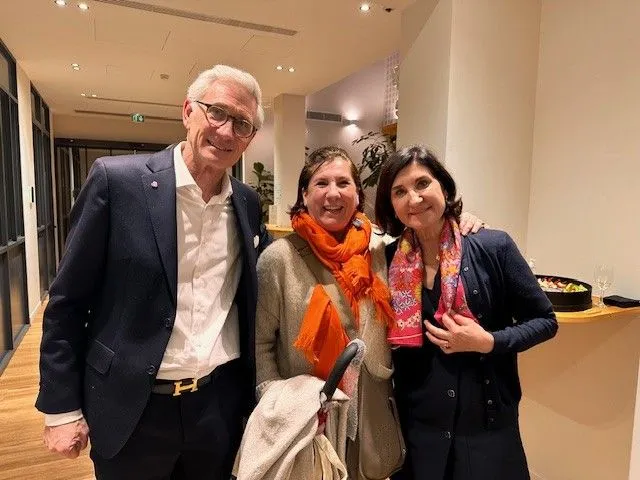
Some emergencies don’t get talked about enough. Cardiovascular disease remains the second leading cause of death among Canadian women, yet it’s still widely seen, in the public imagination, as a man’s disease, and its risk to women is consistently underestimated, even by women themselves. Since 2020, ITC Global has stood alongside the Women’s Cardiovascular Healthcare Foundation to help break that silence, translating its communications on a volunteer basis. Today, we’re honored to work on their most powerful publication yet: “Urgent Action Is Needed, What If It Were You?”, a book that gives voice to fifty women whose lives nearly changed forever, and whose stories can now help save others. Three of the people behind this project join us to talk about it: Céline Imbaud, founding president of ITC Global; Professor Claire Mounier-Vehier, cardiologist at Lille University Hospital and co-founder of the Women’s Cardiovascular Healthcare Foundation; and Thierry Drilhon, business executive and board director, co-founder of the Foundation.
Why is women’s cardiovascular disease still so underestimated, both by women themselves and by those around them?
Thierry: We fight this misconception every single day! Cardiovascular disease isn’t just a men’s issue. Contrary to a particularly stubborn myth, women actually die from it more than men do: one woman every 7 minutes in France. That lack of awareness leads to delayed diagnosis and treatment.
Claire: What’s even more striking is that women are being affected at younger and younger ages, starting in their forties, as their lifestyles have shifted toward the same unhealthy habits long associated with men: smoking, a sedentary lifestyle, being overweight, stress. At the same age, women actually have more risk factors than men, with thinner, more fragile arteries. They also face specific risk periods tied to three key hormonal stages: contraception, pregnancy, and menopause.
Céline: Whenever I ask people around me, and I’ve asked many times since we got involved with the foundation, 90% say breast cancer is the leading cause of death among women. Working with the foundation is what opened my eyes to that misconception. It’s made me even more motivated to support this cause.
“Urgent Action Is Needed, What If It Were You?” brings together 50 testimonials from women ages 22 to 84. What made you want to build this book around their lived experience?
Claire: These testimonials show how important it is to encourage women to take better care of themselves, to make healthcare professionals more attentive to symptoms, to broaden the conversation around the specifics of women’s cardiovascular disease, to give women permission to speak openly about what they’ve been through, and to expand access to screening. We see a wide range of cardiovascular events. Beyond heart attacks, the testimonials cover MINOCA (heart attack with “healthy” coronary arteries), takotsubo cardiomyopathy, postpartum cardiomyopathy, and congenital heart conditions, conditions that are less well known but just as dangerous, with serious consequences for everyday life after the event.
Thierry: These testimonials highlight just how urgent a medical and social issue women’s cardiovascular disease has become. They let people discover it in a very real, concrete way. Our prevention campaigns are designed to reach women directly in their communities, to raise awareness, offer screenings, and get them back into proper care pathways. We’re also working to educate healthcare professionals and train them on the specifics of cardiovascular risk in women. It’s unacceptable today for a wife, daughter, sister, friend, or colleague to die from cardiovascular disease when we know that in 8 out of 10 cases, the event could have been prevented through early detection and management of risk factors. We need to act, and fast! Prevention isn’t a side issue or an optional extra: it’s a choice and a commitment our whole society needs to make. It’s not a cost, it’s an investment that concerns all of us, if we want to grow old in good health.
The Women’s Heart Bus, Women’s Heart Days, Women’s Heart Days in the Workplace, the National Observatory on Women’s Health… How do these initiatives really make a difference?
Thierry: Since 2021, the Women’s Heart Bus has visited 80 cities, staying three days in each one to offer full cardiovascular and gynecological screenings, reaching close to 22,000 women, an average of about 300 women per stop. Over the past two years, more than 80 Women’s Heart Days have screened nearly 5,000 women, roughly sixty per event. In 2025, six Women’s Heart Days in the Workplace were held, reaching close to 350 employees.
Claire: Every stop of the Bus and every Women’s Heart Day is made possible by the extraordinary mobilization of local healthcare professionals: primary care physicians, cardiologists, nephrologists, gynecologists, vascular specialists, midwives, nurses, pharmacists, and more. Over the past five years, close to 6,500 of them have donated their time and expertise to screen, refer, and raise awareness. These events also give them a chance to work together on the specifics of women’s cardiovascular disease, which brings new meaning to their work and counts toward their continuing education.
ITC Global has been volunteering to translate the foundation’s communications since 2020. What sparked that commitment, and why keep it going over the years?
Céline: When Thierry called us one evening to ask for our help, I had no idea how much this initiative would grow! I think what resonated with me from the very start was that our industry is largely made up of women (80% of our staff are women), and that women were at the heart of this cause. On top of that, our work is all about helping clients have an international impact, reaching non-French-speaking audiences. Partnering with them just made sense from day one!
What does skills-based sponsorship, like volunteer translation, bring that other forms of support can’t?
Claire: ITC brings something unique in the very nature of its support: translating our awareness and educational materials. It’s a one-of-a-kind contribution to our work, without which we couldn’t reach women who need translated resources, whether that’s information about our on-the-ground initiatives or materials available on our website.
Thierry: Most of the Foundation’s sponsors provide financial support, and thanks to them, we’re able to make a lasting impact on prevention in women’s lives and carry out all of our initiatives at full strength. Skills-based sponsorship brings something else that’s just as essential: expertise. And that translates into something genuinely useful and valuable for every woman we support.
Céline: Beyond the impact our translation work has in reaching international, non-French-speaking audiences, I think finding meaning in what we do matters just as much within my own team. We’re a business, so profit is still our main driver, but supporting a cause like this lets us step outside our daily routine and, more importantly, actually see the real-world impact of our work. For our project managers especially, it’s meaningful to see those concrete results.
Translating women’s personal testimonials about a cardiac event means dealing with medical language, intimate details, and raw emotion. How does your team approach this kind of content?
Céline: That’s where our expertise comes in. We’ve worked with our linguists for a long time, so we know exactly which ones are best suited to carry a source text over into the target language. For this project, honestly, we talk more about transcreation than translation, because words, expressions, and implications don’t carry over the same way from one language to another. The linguists on this project had to really immerse themselves in the original texts, fully grasp the stakes and the emotion behind them, in order to render them as faithfully as possible to these women’s own words. A translator isn’t just a “word-swapper.” They absorb the content so they can convey the emotion as accurately as possible. That’s exactly what we did for this project.
The English version of the book has just been released, and it’s freely available on womencardiovascularhealthcarefoundation.com. What does that mean to you?
Thierry: We’ll be able to share our experience with a much wider audience, beyond French-speaking borders. Our prevention advice applies to women everywhere, all around the world.
If a woman reads this interview today and takes away just one thing, what should it be?
Claire: She needs to take care of herself, not just everyone else. She should stop self-medicating, try to listen more closely to warning symptoms, stop putting off medical appointments, and make time for herself! Because we want women to take action, rather than simply become victims of a cardiovascular event. Prevention is so effective today. Why not take advantage of it!
Céline: Impact, I think. In the end, everything we do shows just how much of an impact each person can have on others, whether through our work, the foundation’s initiatives, or on our own individual level. Claire often talks about the hummingbird, the parable about doing your own small part even when a problem feels too big, and that’s exactly what this project inspires in me: no matter our job, our personal situation, or our cultural or family background, each of us, at our own level, can make an impact, even if it feels small.